
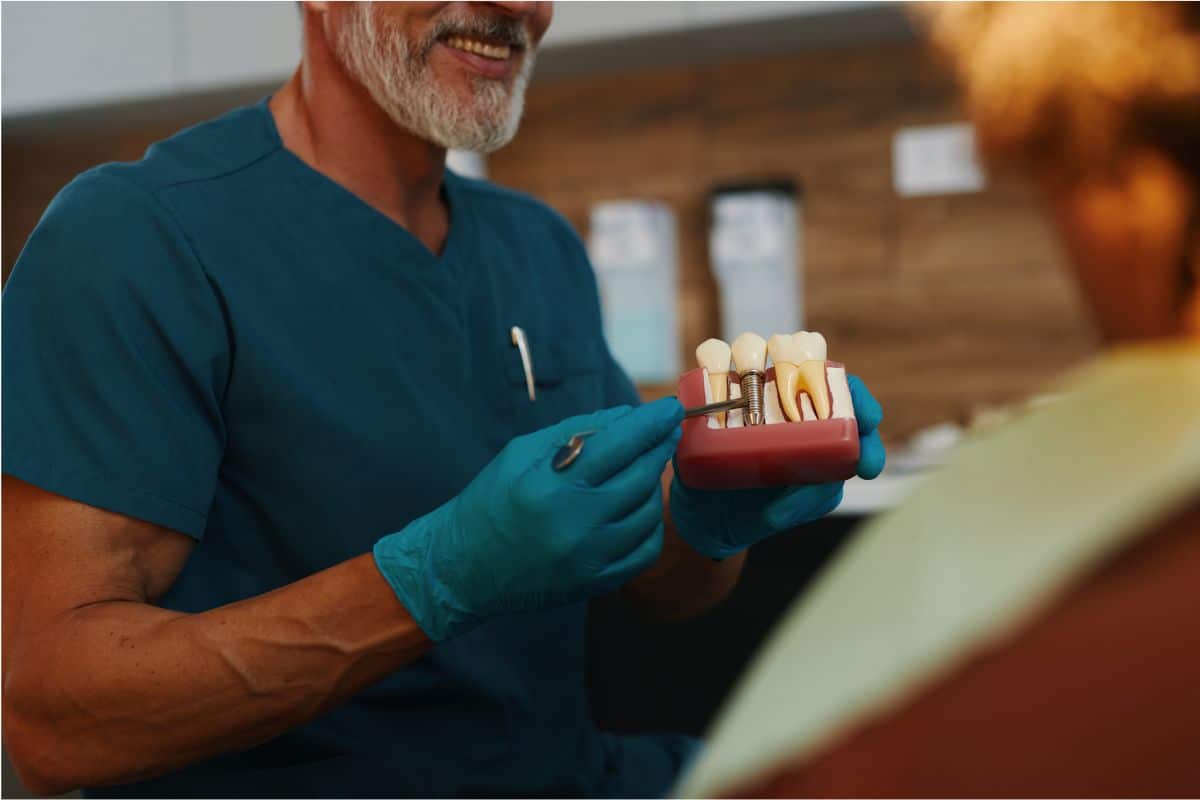
How long should you wait to get a dental implant after a tooth extraction? The answer depends on how the extraction site heals, how much healthy bone remains, the condition of the gums, and whether additional treatment such as bone grafting is needed.
In some cases, a dental implant can be placed on the same day as the tooth extraction. In other situations, waiting several weeks or months allows the soft tissue and jawbone to heal before implant placement.
There is no single timeline that works for every patient. The goal is to choose the timing that provides a stable foundation for the implant and supports healthy long-term results.
If you are considering dental implants in Phoenix after having a tooth removed, understanding the different treatment timelines can help you know what to expect.
Can You Get a Dental Implant Immediately After a Tooth Extraction?
Yes. An implant can sometimes be placed during the same appointment as the tooth extraction. This is known as immediate implant placement.
The International Team for Implantology (ITI) defines immediate implant placement as placing the dental implant in the extraction socket on the same day the tooth is removed.
However, immediate placement is not appropriate for every extraction site.
The implant surgeon must determine whether the socket has the necessary conditions for predictable placement. Factors such as the condition of the surrounding bone, soft tissue, infection, implant position, and ability to achieve primary stability all influence the treatment plan.
This means that having an extraction does not automatically mean an implant can be placed immediately.
How Long Do You Usually Wait After a Tooth Extraction?
Dental implant placement after extraction can generally follow several different timelines:
- Immediate placement: The implant is placed at the time of extraction.
- Early placement: The site is allowed to heal for approximately 4 – 8 weeks before implant placement.
- Early placement after partial bone healing: Implant placement may occur around 12 – 16 weeks after extraction.
- Late placement: The implant is placed after more extensive healing, which may take several months or longer. ITI defines late placement as occurring after complete bone healing, more than six months after extraction.
These timeframes are useful clinical classifications, not rigid rules for every patient.
The actual timing should be based on what is happening inside the extraction site rather than simply counting days on a calendar. ITI guidance emphasizes that implant timing should be based on the desired healing outcome and the condition of the wound.
What Determines When You Can Get a Dental Implant?
Several factors can influence how soon an implant can be placed after extraction.
1. The Amount and Quality of Jawbone
A dental implant needs adequate bone for stability.
When a tooth is removed, the surrounding alveolar bone begins to remodel because the tooth root is no longer providing stimulation. The shape and volume of the ridge can change during healing.
If there is enough healthy bone and the implant can be positioned securely, immediate placement may be possible in an appropriate case.
If the socket has significant bone loss, additional treatment may be necessary before implant placement.
This is one reason implant planning should begin before or around the time of extraction whenever possible.
2. The Condition of the Extraction Site
The condition of the socket matters.
The dentist or periodontist may evaluate:
- Socket anatomy
- Remaining bone walls
- Soft-tissue condition
- Gum health
- Bone volume
- Presence of infection or inflammation
- Ability to achieve implant stability
- Position of nearby teeth and anatomical structures
An extraction site that provides favorable conditions may allow earlier implant placement. A site requiring additional healing or reconstruction may need more time.
3. Bone Grafting
Some patients need bone grafting to rebuild or preserve the ridge before an implant can be placed.
A bone graft may be performed at the time of extraction or as part of a later treatment plan. Dr. Augustine’s practice provides extraction, bone grafting, and implant-related ridge augmentation as part of its periodontal and implant services.
When grafting is necessary, the implant timeline depends on the type of graft, the amount of bone needed, and how the site responds during healing.
In other words, a bone graft does not automatically mean that implants are off the table. It may simply mean that the treatment needs to be staged.
What If the Tooth Had an Infection?
A tooth may need to be extracted because of severe decay, infection, periodontal disease, or another dental problem.
An infection does not automatically determine one universal implant timeline. Instead, the condition of the extraction site and surrounding tissues must be evaluated before implant placement.
The treatment plan may involve removing the tooth, managing the infection, preserving or rebuilding the bone, and allowing the tissues to heal before placing the implant.
In selected cases, immediate implant placement may still be considered. In others, allowing the site to heal first may provide a more appropriate foundation.
The important point is that implant timing should be determined by the clinical condition of the site, not simply by the fact that an infection was present.
Why You May Not Want to Wait Too Long
Waiting for the appropriate healing period is important, but that does not mean delaying treatment indefinitely.
After tooth loss, the jawbone undergoes remodeling. The ridge can gradually change in shape and volume because the natural tooth root is no longer present.
This can affect future implant treatment.
If substantial bone volume is lost, additional procedures such as bone grafting or ridge augmentation may become necessary.
That does not mean an implant must always be placed immediately. Instead, it means that replacement planning should begin early so the condition of the extraction site can be monitored and preserved when appropriate.
Immediate vs. Early vs. Delayed Dental Implant Placement
Understanding the terminology can make the treatment timeline easier to follow.
| Implant Timing | General Timeframe | What It Means |
|---|---|---|
| Immediate | Same day as extraction | Implant is placed directly into the extraction socket |
| Early | About 4 – 8 weeks | Soft tissue has healed before implant placement |
| Early with partial bone healing | About 12 – 16 weeks | More bone healing has occurred before placement |
| Late | More than 6 months in ITI classification | Implant is placed after complete bone healing |
These classifications come from established implantology consensus guidance.
The important distinction is that the timing of implant placement is not the same thing as the timing of implant restoration.
Once an implant has been placed, it still needs to integrate with the surrounding bone. This biological process is called osseointegration.
How Long Does a Dental Implant Take to Heal After Placement?
Getting the implant placed is only one stage of treatment.
After placement, the implant needs time to integrate with the jawbone before the final restoration is completed. The exact healing period varies based on the implant site, bone quality, implant stability, treatment protocol, and whether additional procedures were performed.
ITI guidance distinguishes implant placement timing from loading protocols, including immediate, early, and conventional loading.
This is why a patient should not assume that an implant placed immediately after extraction means the entire tooth replacement is finished that same day.
In selected full-arch cases, immediate provisional teeth may be possible. Dr. Augustine’s Teeth-in-a-Day treatment page describes protocols in which implants and replacement teeth can be provided during the same overall treatment process for appropriate patients.
That is different from saying that every single-tooth implant can be extracted, placed, and permanently restored in one appointment.
What If You Wait Several Months After Extraction?
A dental implant can still be placed after several months or longer.
However, the longer the site has been without a tooth root, the more opportunity there may be for changes in the alveolar ridge.
If enough bone remains, implant placement may proceed normally.
If significant bone resorption has occurred, the treatment plan may include:
- Bone grafting
- Ridge augmentation
- Sinus augmentation for certain upper-jaw sites
- Soft-tissue procedures
- A staged implant placement approach
Dr. Augustine’s practice provides implant-related ridge augmentation and sinus grafting as part of its implant and periodontal services.
Therefore, waiting does not necessarily eliminate the possibility of an implant, but it can change the amount of preparation required.
How Do You Know When Your Extraction Site Is Ready?
A visual examination alone may not provide enough information to determine whether an implant can be placed.
During an implant consultation, the clinician may evaluate the:
- Extraction socket
- Jawbone volume
- Bone density
- Gum tissue
- Adjacent teeth
- Bite
- Overall periodontal health
- Location of important anatomical structures
3D imaging such as CBCT may also be used when appropriate to evaluate the bone and anatomy in greater detail.
The objective is to determine whether there is enough healthy bone and soft tissue to support the planned implant and whether additional treatment is needed first.
Why Planning Before Tooth Extraction Can Matter
If you already know that a tooth needs to be removed and you are considering replacing it with an implant, it can be helpful to discuss implant planning before the extraction.
That allows the implant team to consider:
- Whether immediate placement may be possible
- Whether socket preservation is appropriate
- Whether bone grafting may be needed
- How much bone is available
- Where the future implant should be positioned
- How the extraction may affect the future restoration
ITI consensus recommendations state that treatment planning for implant therapy should begin once the need for extraction has been confirmed, with the implant placement and loading protocol considered before extraction.
This approach can help avoid treating the extraction and implant as two completely unrelated procedures.
Dental Implants in Phoenix: What Should You Expect After an Extraction?
If you recently had a tooth removed or know that an extraction is necessary, the next step is not necessarily to wait a predetermined number of months.
Instead, the timing of your implant should be based on the condition of the extraction site and your overall treatment needs.
At Dr. Jason Augustine DDS, implant treatment is provided within a periodontal and surgical implant practice in Phoenix. Dr. Augustine has practiced periodontics and implant dentistry in Phoenix since 2000 and provides dental implants, tooth extractions, bone grafting, ridge augmentation, sinus grafting, and full-arch implant treatment.
An evaluation can help determine whether you may be a candidate for immediate implant placement or whether your extraction site would benefit from a period of soft-tissue healing, bone healing, or additional bone-building treatment first.
If you are considering dental implants in Phoenix, visit our dental practice in Phoenix, to discuss your tooth replacement options and develop a treatment plan based on your individual needs.
Frequently Asked Questions
1. Can a dental implant be placed the same day as a tooth extraction?
Yes, in selected cases. Immediate implant placement means placing the implant in the extraction socket during the same procedure. Whether this is appropriate depends on factors such as the condition of the socket, available bone, soft tissue, and ability to achieve implant stability.
2. How long after a tooth extraction can I get an implant?
There is no single waiting period. Depending on the case, an implant may be placed immediately, after approximately 4 – 8 weeks of soft-tissue healing, after approximately 12 – 16 weeks of partial bone healing, or after a longer healing period.
3. Is it better to get an implant immediately after extraction?
Immediate placement is an established treatment option, but it is not automatically appropriate for every patient. The condition of the extraction site and the ability to achieve predictable implant stability must be considered before selecting the timing.
4. What happens if I need a bone graft after extraction?
A bone graft may be used to preserve or rebuild the jawbone so it can better support a future implant. The timing of implant placement depends on the amount of bone needed and how the site heals.
5. Can I get a dental implant months after an extraction?
Yes. Dental implants can be placed in healed extraction sites. However, bone remodeling after tooth loss may mean that additional procedures are necessary if sufficient bone volume is no longer available.
6. How long does a dental implant take to fully heal?
The timeline varies according to implant location, bone quality, primary stability, surgical procedures, and the restoration protocol. Implant placement and implant restoration are separate stages, and the implant must biologically integrate with the surrounding bone before the final restoration is completed in conventional protocols.
The Bottom Line
You do not necessarily have to wait months after a tooth extraction to receive a dental implant. In carefully selected cases, an implant can be placed immediately. Other patients may need approximately 4 – 8 weeks, 12 – 16 weeks, or several months of healing before placement.
The right timeline depends on the condition of the extraction socket, available bone, gum health, infection or inflammation, implant stability, and whether procedures such as bone grafting are required.
If you need a tooth extraction and are considering an implant, planning the replacement early can help preserve treatment options. Rather than choosing a waiting period based only on a calendar, have the extraction site evaluated and develop a treatment plan around how your bone and soft tissues are healing.
If you are considering dental implants in Phoenix, schedule a consultation with Dr. Jason Augustine to discuss your extraction site, bone levels, implant timing, and whether additional procedures may be needed before implant placement.
